

American Hubris
This won't end well...

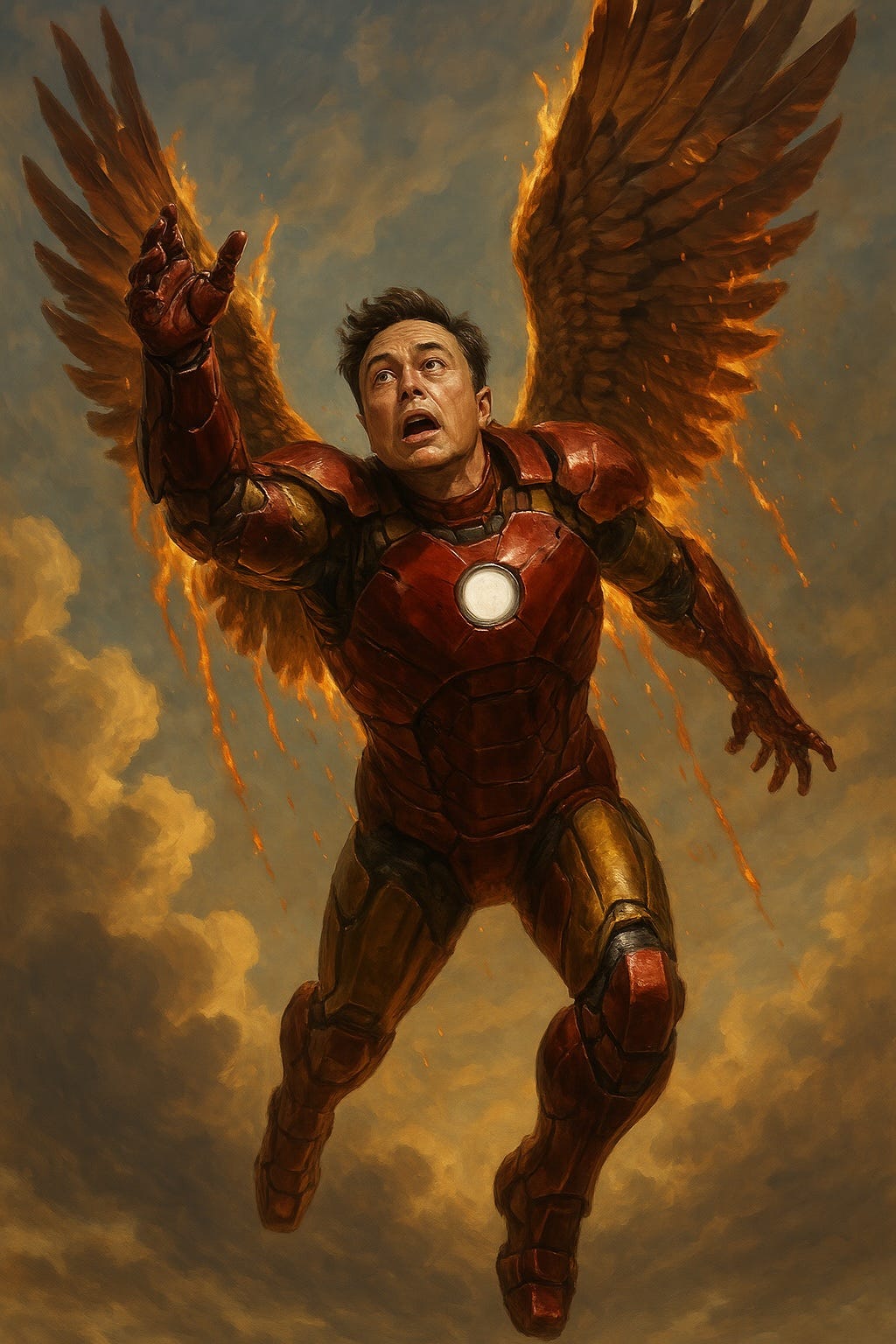
In Ancient Greek, the term hubris (ὕβρις) was used to describe a form of arrogance or overweening pride that — at least in the world of the Greek myths — invariably preceded downfall. Hubris in this original sense is not simple pride, but rather a type of unbounded self-confidence that acknowledges no limits, trampling taboos without any regard for the consequences. Hubris also had a legal meaning in Greek society, meaning something like outrageous or violent behaviour that humiliates another, especially when motivated by contempt rather than personal gain — like assaulting someone just for the thrill of domination. Perhaps this is already ringing a bell.
For the Greeks, hubris was personified in figures like Pentheus, Prometheus and Icarus, tragic figures who all met their doom after trespassing against the gods. Pentheus, the king of Thebes, refused to acknowledge that Dionysus, the god of festivities, wine and states of rapture and abandon, was a legitimate deity and ended up being torn limb from limb by the maenads, Dionysus’s ecstatic followers. Prometheus famously stole fire from the gods for the use of humans, and was punished by having his liver pecked out by an eagle every day for eternity. And Icarus, who fashioned wings out of wax and feathers, ignored warnings not to fly too high, and fell to his death in the sea after his wings melted when he flew too close to the sun.
Of course it is true that a certain amount of hubris is required to make major scientific and technical discoveries. Too much respect for tradition is often a hindrance to innovation. In the history of science it is often the iconoclasts, eccentrics and rebels who make the breakthroughs. The early inventors of quantum mechanics were largely young men full of ego and the arrogance of youth; the new science was referred to as “Knabenphysik” (boy’s physics) at the time because of the youth of its exponents. And it’s not for nothing that Oppenheimer’s biography was titled “American Prometheus”: the Prometheus myth captures perfectly the hubris of the act of building an atomic bomb — stealing fire from the gods — and the consequent moral torment that ensued for the man described as its father.
It’s also no coincidence that Oppenheimer was American. Although the most important scientific discoveries of the last two centuries were mostly made by Europeans, it is America’s brash, youthful, irreverent culture of “move fast and break things” that has been responsible for the vast majority of the technical innovations that have come to define modern life, from cars to smartphones to the internet to AI. It’s an attitude that can be traced far back into the history of the nation, which was built on the bonanza of the discovery of the “New World” and stood in defiance of all the staid traditions of Europe.
Yet the rejection of tradition and limits that has been so key to American leadership in technical innovation has revealed its dark side in recent years — if atomic weapons weren’t enough! The spectacular fall of Elizabeth Holmes and her blood-testing company Theranos is a cautionary tale for how easily unfettered self-belief and an attitude of “fake it till you make it” can shade into fraud and self-delusion. Holmes won billions of investment dollars with her machines that could get test results from a single drop of a patient’s blood. Except that they couldn’t. Holmes’s machines were classic “vaporware” — a product presented as real which in fact is little or nothing more than a vision in someone’s head.
The Holmes story — like that of disgraced crypto mogul Sam Bankman-Fried — was treated as an anomaly, a case of a dishonest bad actor taking advantage of investors greedy for the next “unicorn” startup during the years of near zero interest rates. Yet she was merely a symptom of tech hubris amplified beyond all limits by angel investor dollars.
I know this because I have witnessed it first-hand working in the tech industry. Borderline fraud was endemic across the industry during the free money years. In one case I saw a product hyped up to technologically illiterate executives from a large corporation with a production-TV level video presentation and a slick-looking demo that was all smoke and mirrors held together by little more than sticky-tape and prayers.
Prior to the pitch the CTO, channelling what I am sure he thought was the ghost of Steve Jobs, made absurd demands on the engineering team which I was a part of, for example setting the goal that our core processing engine be sped up by a factor of ten thousand in two weeks. Developers huddled in an online “war room” until late into the night for the fortnight leading up to the presentation, red-eyed and jittery with caffeine and stress, trying whatever desperate hacks they could come up with to achieve the fundamentally impossible targets. They failed; the presentation went up in flames, and still somehow the clueless corporate execs signed up for the product, a steaming pile of camel dung that ultimately would need to be thrown out and rewritten from scratch.
Such experiences, repeated many times, opened my eyes to the ugly reality underpinning much of the tech industry and made me profoundly sceptical of the hype cycle it thrives on. Genuine breakthroughs are extremely rare. The market for apps and digital services is thoroughly saturated and hitting on a truly new idea is nigh-on impossible. Everyone confronts the same globalized technological landscape and has access to the same informational resources. Highly talented engineers are everywhere. The days of a lone Steve Wozniak building a breakthrough device in his garage are long gone. Yet the industry thrives on the mythology of maverick figures like Wozniak, Jobs and Musk. The myth is distilled to its essence in the Hollywood figure of Iron Man, a modern Icarus story without the crashing bit.
The idea persists that the only thing holding us back from a sci-fi utopia is a lack of imagination and boldness. It sounds wonderful, but the Elizabeth Holmes case shows how toxic it can become. What is striking watching footage of Holmes during her Theranos days is her strangely unfocused stare. It is as if she is looking at a picture superimposed on top of the world instead of the world itself, which is, I would submit, exactly what she is doing. She does not see reality, but rather the fantasy she has substituted for it.
The consequences — for herself, her investors, and all those connected to her business — were dire. Yet even from prison she maintains her innocence, apparently sincerely. Despite her spectacular Icarus impersonation, her deluded grandiosity remains intact: from prison she has drafted a piece of legislation she calls the “American Freedom Act” which aims to “bolster the presumption of innocence and change criminal procedure”.
Elon Musk is governed by the same fundamental constellation of beliefs and myths. Musk has cultivated an “Iron Man” persona, promoting the notion that it is his lone, personal genius that is responsible for Tesla’s cars, SpaceX’s rockets and Neuralink’s brain implants. Yet Musk’s biographer Seth Abramson recently concluded that there is “no evidence” that the billionaire has “any intellectual achievements”. He is, in Abramson’s telling, simply a financier whose investments have paid off spectacularly.
The enormously inflated valuation of Tesla stock relative to other carmakers (even after the recent declines) is a tangible manifestation of the deep cultural investment in the Iron Man myth that Musk embodies, however far from reality it may be. Musk has a long history of making outrageous promises on which he completely fails to deliver, or delivers only in radically diminished form. Somehow, however, when it comes to Musk, investors seem to have the memory of goldfishes, and forgive each failure as it becomes eclipsed by the next fantastical promise. The grip of the Iron Man myth is, well, iron.
The list of these failures is so long that it would take more than a whole article to do them justice. The following is just a choice selection of the most egregious.
In 2014, Musk promised “90% autopilot” by the following year, yet no such breakthrough occurred. In 2016 he promised a fully self-driving Tesla that could navigate from Los Angeles to New York with no human intervention by the following year, yet this coast-to-coast autonomous trip also did not happen — either then or anytime since. Even today, more than a decade after Musk promised it, Tesla’s “Full Self Driving” mode still requires active supervision and is far from ready to replace human drivers.
Then there was Musk’s out-of-the-blue promise in 2017 to build a Hyperloop — an ultra-fast vacuum tunnel transport — from New York City to Washington, D.C. The project never materialized and eight years later the “Boring Company” has only completed a single one-mile long test tunnel in Las Vegas. Boring indeed!
In the same year as the Boring promises, Musk promised manned missions to Mars with cargo delivered by 2022 and humans two years later. Yet as of now Starship — the vehicle intended for Mars — has not even reached orbit successfully and continues to “do an Icarus” on a regular basis. In the meantime, some calculations have suggested the cost of settling a colony of one hundred people on Mars (let alone the one million Musk has talked about) would cost more than the entire GDP of planet Earth.
This is not to mention the undelivered promises on human brain implants by Neuralink, his promise to fly Japanese billionaire Yusaku Maezawa around the moon by 2023, the ongoing Cybertruck debacle, the $25,000 fully autonomous car also promised by 2023, the Optimus robot prototype by 2022, the Roadster that never was, the semi truck under-delivery, the promise of “one million robotaxis by 2020” and on and on…
Holmes’s lies look pretty pedestrian when compared to this compilation of astronomical whoppers, and yet this bloviating conman has not only escaped any form of reckoning, but has been promoted to de facto co-president where he has taken to rooting through a stunned federal bureaucracy like a wild boar let loose in a crowded disco. He continues to make his ludicrous boasts and promises, such as finding one trillion dollars in “waste, fraud and abuse”.
This pathological hubris is a deep cultural problem that has now metastasised to the federal government. Trump is another face of this same phenomenon of American arrogance untethered from reality. Just like Musk, he has promised the world and more: instant resolution of the world’s most intractable conflicts, an economy “booming like no economy in the history of the world”, immediate deportation of all illegal immigrants, cessation of inflation, a wall across the southern border that Mexico would pay for, etcetera. And just like Musk, he continues to evade all accountability for his failure to deliver on any of this, or for other grotesque derelictions of duty such as his mismanagement of the Covid-19 pandemic, which resulted in hundreds of thousands of unnecessary deaths in the US.
The problem here is clearly not Musk or Trump in and of themselves. It is the cultural hubris they embody and which has lifted them into the positions they currently occupy. This social pathology sustains the valuation of Tesla in the face of all reason and manifests in the impenetrable shell of denial with which their followers armour themselves. Over years of evading consequences for deception, both Trump and Musk have realised that they now inhabit a parallel universe in which truth has no relevance and cannot constrain them. Fantasy and self-delusion have completely replaced reality, and the American public has become complicit by elevating narcissistic fantasy to the role of its central governing principle.
In Greek myth, hubris invariably predicts a catastrophic fall. In part, this reflects Ancient Greek conservatism: stories about the punishment of those who offended the gods can be read as morality tales intended to curb the enthusiasm of those who would challenge the social order. Yet at another level, these myths can be interpreted as encoding cultural and psychological wisdom.
Really, the downfall that follows on acts of gross hubris in Greek mythology reflects the simple truth that there is a cost to ignoring reality. The size of the crash that follows is proportional to the extent of the denial. What goes up must come down. Debts borrowed against reality must eventually be repaid. Right now, American hubris seems to have reached its apogee. Narcissistic delusion, in the form of the unholy alliance of Trump and Musk, has triumphed. Yet make no mistake: there is a bill being tallied somewhere for all this folly, and it will be paid one way or another. The only question is how much of the America we know will be destroyed when the reckoning comes.